Friday, April 08, 2022

Reflections on recent rainfall and spring wildfire season in New Jersey

When the US Drought Monitor released their weekly map of drought conditions in the United States on Thursday, April 7th (valid for April 5th), I was not surprised to see that southern New Jersey remains under a moderate drought and the rest of New Jersey continues as abnormally dry. While we had what may have been a normal amount of rain last week, it was not enough to change drought conditions in New Jersey. So if we only look at current drought conditions, it might seem that New Jersey remains dry and with spring wildfire season either currently under way or under way soon then these apparent dry conditions may not bode well for the spring wildfire season.

Obtained on April 8, 2022 from https://droughtmonitor.unl.edu/

According to the main page of the Drought Monitor website, "the data cutoff for Drought Monitor pas is each Tuesday at 8 a.m. EDT. The maps, which are based on analysis of the data, are released each Thursday at 8:30 a.m. Eastern Time.

However, New Jersey has experienced two low pressure systems since Tuesday evening April 5th bringing a great deal of rain to much of New Jersey. Since the cutoff for data is 8 a.m. on Tuesdays, I feel safe in saying that the rainfall that we got in New Jersey occurred after the cutoff for the April 7, 2022 U.S. Drought Monitor Map. By the way, I checked with someone at my local NWS Weather Forecast Office in the in Mt. Holly NJ who told me that I was correct in saying that Tuesday's rainfall in New Jersey started Tuesday evening. 

I wonder if this rainfall may alleviate the drought in New Jersey? I am unable to provide a definitive answer to this question while we await for the U.S. Drought Monitor to come out with new maps next Thursday, April 14th, I turned to the NWS Middle Atlantic River Forecast Center because they monitor water supply and precipitation, among other things, across the river basins in their forecast area. 

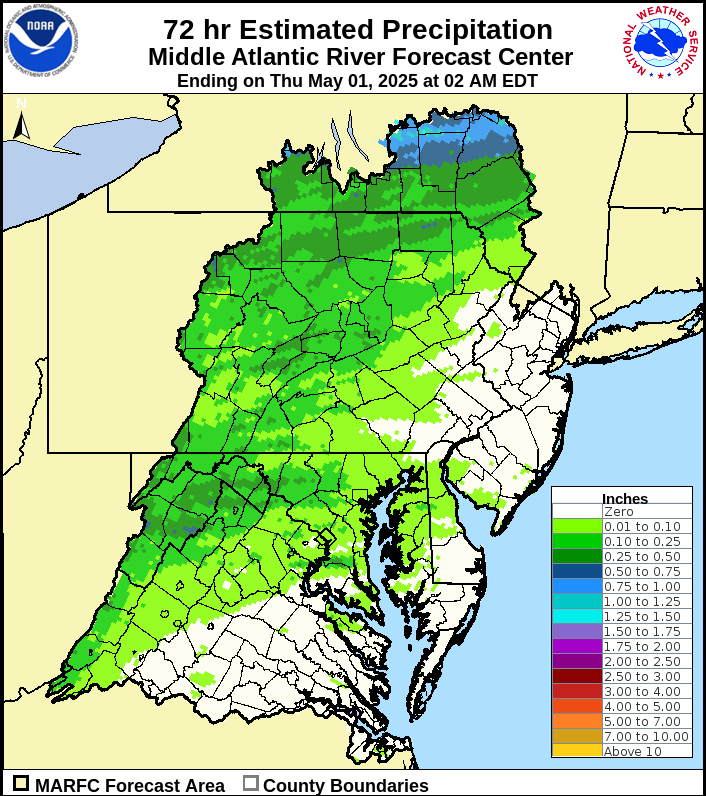
The NWS Middle Atlantic River Forecast Center (NWS MARFC) has two types of precipitation data that might be helpful. The first are maps showing 24, 48 and 72 hour accumulated rainfall across the river basins included in their forecast area . The map that I am sharing here is the 72 hour estimated precipitation from the NWS MARFC for the 72 hours ending at 1 PM on Friday, April 8, 2022. Note the dark purples, reds and oranges in New Jersey, indicating rainfall in excess of 1.75 inches with some areas having estimated precipitation of 2.5 inches or more


Obtained on April 8, 2022 from https://www.weather.gov/images/marfc/mpe/past72.png

I had a conversation with the hydrologists at the NWS MARFC who reminded me of their precipitation departure maps. As the name implies, these maps show precipitation departures from normal across their forecast area. They produce these maps for varying time periods from 7 days up to the last 365 days. I choose the year to date map for New Jersey to share with you (January 1, 2022 through April 7, 2022). If we continue to have rainfall close to average in the immediate future, and we may not, there is cause for some optimism as many counties in New Jersey havre precipitation departures just above average or less than an inch below average. Only two counties have precipitation departure of minus one inch or more.

Obtained on April 8, 2022 from https://www.weather.gov/marfc/NJPrecipitationYTD


So I am cautiously optimistic that we may be close to turning the corner from abnormally dry or moderate drought conditions to a better situation in southern NJ and normal conditions (no drought or dry conditions) in central and northern NJ. Time will tell, I will be back next week with an up date on drought conditions in New Jersey. By the way, I am aware that we in New Jersey and elsewhere in the northeast are relatively lucky as there are extreme drought conditions in the western U.S. 


Wednesday, April 06, 2022

2021 wildfire season: Idaho City Hotshots 2021 crew video

As a non-firefighter who is interested in wildland firefighting,  I always enjoy watching wildfire crew videos. Enjoy this sixteen minute of the Idaho City Hotshots 2021 season.


Direct link to video uploaded by Krossed Saints

Tuesday, April 05, 2022

This just in: wildfire in Wharton State Forest NJ

April 5 7:20 PM

Thanks to my friends from the NJ Forest Fire Service Section B10 for telling me about a 62 acre wildfire burning near High Crossing, a ghost town located in Wharton State Forest in Burlington County, NJ (NJFFS Section B3). I know no other information at present. I will update this post when I know more information. 


April 6 8:42 AM

I have no further information about the 62 acre fire in Wharton State Forest. I do know that it rained across all or much of New Jersey last night. If there was rainfall over this fire then I expect that the rain aided the firefighters. 

Reflections on upcoming spring wildfire season in NJ

As we may be near the end of the spring prescribed burning season here in New Jersey and with the spring wildfire season soon upon us, my thoughts turn to paying even closer attention to current and forecasted weather than I do at other times of year. This week, the first full week in April may be a damp week in New Jersey and environs. If that weather forecast holds, then it may mean reduced risk of wildfires. I say maybe because after following and continue to learn about wildfires, I know that even when wildfire risk is minimal that there is still a chance, however minimal, that wildfires may still burn. 

We have been in an abnormally dry period in central and northern New Jersey for the last couple of weeks, with southern New Jersey in moderate drought conditions (see my March 28th post) According to the last update from the US Drought Monitor  (updates available each Thursday reflecting conditions two days before, archived data also available). We had some rain the middle of last week and this weekend but I am not sure if this was enough to to alleviate the dry and drought conditions in New Jersey. So even with forecast rain, I remain concerned about continuing dry conditions in New Jersey and the prospects for a worse spring wildfire season. Of course my concerns are just that concerns, as I am not a Meteorologist nor am I a wildland firefighter.

Obtained on April 5, 2022 from https://droughtmonitor.unl.edu/

My concerns about the severity of the spring wildfire may or may not materialize. Even so, there are things that I can do, such as monitoring weather forecasts from the NWS Weather Service as well as monitoring current fire danger. In New Jersey I can monitor current fire danger through the NJ Forest Fire Service (NJFFS) webpage where the NJFFS has an information page on conditions and restrictions. For those of you who live outside of New Jersey, you may want to monitor wildfire conditions through your states forest fire service or the equivalent. There are two NWS Weather Forecast Offices (NWS WFO) in New Jersey covering different parts of the state. The NWS WFO in Upton New York covers the five northeastern counties, The NWS WFO in Mt Holly NJ covers the rest of New Jersey.

There are some tips from the NJ Department of Environmental Protection (NJDEP.). The NJ Forest Fire Service is one of the divisions of the NJDEP.

Some of these tips are easy for me to follow as I have no children, I do not smoke, and I have not used my indoor fire place in a few years. I used to camp when I was younger and was taught by my Dad how to be sure that our campfire was fully doused when we left the campsite and an adult was always around when the campfire was lit. After having a lantern catch fire when I was a kid that scared the you know what out of us, we always brought a fire extinguisher along on our family camping trips. I try to be sure that my driveway is accessible if for no other reason than I need to be sure that the fuel delivery trucks can access the driveway. 

As for defensible space, I keep leaves out of my gutters because if I do not the gutters get clogged.  I admit the while most of the gardens adjoining my house are covered with stone, there is some leaf detritus around and I need to be better at keeping the leaves and the like away from my house.  Yes, I have various perennials and shrubs planted. If I were in an area with higher overall widfire danger, I would have to carefully consider what I plant. 

The closest I came to a small brush fire was when a utility transformer on a pole across the street caught fire. That was scary but my local Volunteer Fire Company was on the ball putting the fire out once the power county cut power to the utility transformer in question. This just goes to show that fires of any kind can crop up and it does pay to be fire aware.


Monday, April 04, 2022

About wildfires: some terminology

 As sometimes happens I got involved in a couple of appointments out of the house and then some important personal business, so I am unable to make the post that I intended to make today. I will try to make up for this tomorrow. In the meantime, here is a short video about some commonly used wildfire terminology.


Direct link to video from WBIR Channel 10 (Tennessee) on YouTube

Friday, April 01, 2022

Friday Fun: A look at the Beech 18

 I became acquainted recently with the Beech 18 aircraft through reading I'll Take the 18: The Story of Beech 18 Freight Flying by Scott H. Gloodt. I had a great time reading about flying freight in the Beech 18 and learned about the Beech 18 and her capabilities. It is available from many e-book vendors. Here is a video that Gloodt did about the book.


Direct link to video on Youtube from Lifted Up Productions


 Here is another video about flying the Beech 18 In the video below you will experience flying in a Beech 18.


Direct link to video on Youtube from Section Eleven Outdoors


Wednesday, March 30, 2022

2022 NJ wildfire season: Prescribed burns (March 29th & 30th)

The New Jersey Forest Fire Service continues to conduct prescribed burns this week. The schedule of prescribed burns is dependent on favorable weather conditions.

Burlington County 
- Pemberton Township - Brendan T Byrne State Forest
- Pemberton Township - Private Property 
Ocean County
- Lacey Township - Greenwood Forest Wildlife Management Area
- Manchester Township - Brendan T Byrne State Forest
- Jackson Township - Municipal Property
Passaic County 
- Ringwood Borough - Ringwood State Park
Somerset County 
- Bernards Township - County Property

Burlington County 
- Pemberton Township - Brendan T Byrne State Forest
- Woodland Township - Private Property 
Cumberland County 
- Downe Township - Millville Wildlife Management Area
- Lawrence Township - Millville Wildlife Management Area
Monmouth County
- Wall Township - Private Property 
Ocean County
- Jackson Township - Colliers Mills Wildlife Management Area
- Manchester Township - Brendan T Byrne State Forest
Sussex County 
- Andover Township - Kittatinny Valley State Park

Obtained on March 30, 2022 from https://www2.census.gov/geo/maps/general_ref/stco_outline/cen2k_pgsz/stco_NJ.pdf


Monday, March 28, 2022

2022 NJ wildfire season: March 28th update

 As I write this, it is abnormally cold with windy conditions as we approach spring fire season. We are also in a period of abnormally dry conditions in the northern part of New Jersey. I am not sure what these abnormally dry conditions bode for New Jersey, but I suspect that in the short term the dry conditions will complicate the spring fire season as dry conditions only increase wildfire danger. Today’s Fire Weather Planning Forecast from the NWS Mt Holly provides an overview of today’s fire weather concerns. Note that this is a planning forecast, New Jersey is not under a Red Flag Warning nor is there a Special Weather Statement for elevated wildfire concerns. to make matters even more interesting there is a chance of snow showers this afternoon.


Obtained on March 28, 2022 from https://droughtmonitor.unl.edu/


Fire Weather Planning Forecast
 National Weather Service Mount Holly NJ
 1006 AM EDT Mon Mar 28 2022
 
 .DISCUSSION...
 A cold and dry airmass will be in place today. Surface dew points 
 drop into the single digits to as low as 5 below, and west-northwest 
 winds 15 to 20 mph with gusts to 25 to 35 mph. Minimum relative 
 humidity values today will range from 20 to 25 percent (a little 
 higher in parts of the southern Poconos). Although scattered 
 flurries are possible in the afternoon, measurable precip is not 
 expected.
 
 Conditions only slightly improve on Tuesday with northwesterly
 winds 10 to 15 mph with gusts to 25 mph, and minimum relative
 humidity values ranging from 20-25% for most locations. There 
 will be much more sunshine Tuesday compared to today and 
 slightly warmer temperatures in the low to mid 40s.


It is brisk and cold here but I know that the NJ Forest Fire Service is taking care of those of us in New Jersey to keep us as safe as possible from wildfires. According to the NJ Forest Fire Service Section B10  , fire towers in northern (NJFFS Section A) and Central New Jersey (NJFFS Section B) are staffed today, March 28th. Note that they NJFFS updates their website frequently so what you see may be different. I have no idea if these towers have a source of heat, if not it is cold. Likewise, if there is a wildfire, no matter how small, crews from the NJFFS along with local mutual aid as applicable will fight the wildfire.

Thank-you NJFFS!  

Friday, March 25, 2022

In honor of women's history month: women in aviation in the U.S. over 100 years

 In honor of women's history month, I want to share a nice video from Mike Machat on "Women in Aviation - From the early pioneers to today's talented female aviators." The focus here is on female aviators in the United States. I enjoyed this video and I hope you do as well. Allow under nineteen minutes to watch the video. 


Wednesday, March 23, 2022

2022 wildfire season: first IMET deployments of 2022

About three weeks before the annual Incident Meteorologis (IMET) continuity of excellence exercise (March 7 to 11, 2022), the first IMET in 2022 was deployed on February 19th. The IMET, from the US National Weather Service Office in Las Vegas was deployed to the Airport Fire near Bishop, California that was contained on or about February 26. 

In the past week, two more IMETs were deployed. One of these deployments, to a wildfire in Ohio,  serves as a reminder that IMETs are a national resource. 

March 16th deployment

March 18th deployment

IMETs save lives!

Monday, March 21, 2022

2022 NJ wildfire season: fire activity and prescribed burning (March 21)

The New Jersey Forest Fire Service continues to be busy working wildfires to keep us safe and finishing up with prescribed burns. 

A wildfire was reported on Saturday, March 20th in Leisuretown, Southampton Township (Burlington County, NJ). This 50 acre wildfire is currently at 75% containment.


NJ Forest Fire Service Fire Towers are being staffed:

In the meantime prescribed burns are being conducted today, March 21st in Morris County, Somerset County and Ocean County.


Friday, March 18, 2022

BAe-146 retardant drop (Billings MT)

I sometimes like to post aviation videos on Friday. Today I wanted to share a video of an air tanker drop, one that I had not shared previously. I found this video of a BAe-146 airtanker working with a lead plane on a wildfire north of Billings, Montana. I am not sure the date of this drop, that does not matter. Enjoy this video uploaded by TC's Aviation Studio.


Direct link to video on YouTube uploaded by TC's Aviation Studio.

Wednesday, March 16, 2022

About Incident Meteorologists

Last week the US National Weather Service Incident Meteorologist's (IMET) had their annual Continuity of Excellence Exercise (see my March 9th post for more information).  See this article from kivitv about this training. As a part of this annual training exercise, there was a media day on March 10th. Here is a video from KTVB about IMET training and the important role that IMETs play in helping wildland firefighters stay safe.


Direct link to video from KTVB

See also this March 9 story from KIVITV about what IMETs do.

IMETs save lives!!

Monday, March 14, 2022

About prescribed burns in New Jersey


Direct link to video from the NJ Department of Environmental Protection


I do try to use this blog to highlight what the New Jersey Forest Fire Service (NJFFS) does to keep us safe from wildfires. One of the things that the does to keep us safe in late winter and early spring is conducting prescribed burns. In recent weeks I have been posting about when and where the NJFFS has conducted prescribed burns, see for example my March 4th post.

As I was preparing for today's post,  I reread this February 9th news release from the NJ Department of Environmental Protection (DEP) on the NJFFS 2022 prescribed burn season. I must have given this news release a more careful read than I did a few weeks ago, as I noted a couple of links to YouTube videos about prescribed burns, one of which tI shared above on how the NJFFS uses and constructs plow lines in southern NJ in preparation for conducting prescribed burns. I found this insightful and I hope you do as well. I never stop learning.

When I came across the following Facebook post shared by the NJFFS A7-8 Association on Facebook earlier this morning, I knew that I had to share it with you. The video was posted by the NJ Department of Environmental Protection who was on scene earlier this month during a prescribed burn at the Bass River State Forest in the NJ Pine Barrens. In this video you will hear from the Shawn LaTourette, the Commissioner of the NJ DEP, Greg McLaughlin, Fire Warden and NJFFS Chief, and Dave Golden, Assistant Commissioner for Fish and Wildlife talk about how and why the NJFFS conducts prescribed burns in New Jersey.


Friday, March 11, 2022

A day in the life a NWS Incident Meteorologist

 I wrote about the annual NWS Incident Meteorologist (IMET) Continuity of Excellence Exercise on March 9th. This week the NWS Incident Meteorologist Facebook page continues to make a series of nice posts about this training and related matters. Today I am going to share four posts highlighting a day in the life of an IMET, these three posts are summarized here


A typical day in the life of an IMET: 4:30 AM to 6 AM


A typical day in the life of an IMET: 7 AM to 10 AM


A typical day in the life of an IMET: 11:30 AM to 2:15 PM


A typical day in the life of an IMET: 7 PM to 10 PM

Wednesday, March 09, 2022

NWS Incident Meteorologists: 2022 Continuity of Excellence Exercise

The US National Weather Service Incident Meteorologists are in the midst of their 2022 Continuity of Excellence Exercise or CEE. The IMETs are meeting in Boise Idaho this week (week of March 7th) for CEE with what sounds to me like an opportunity to review important forecasting, safety concerns and other related issues that they will need when they are assigned to a wildfire to provide onsite weather forecasting. The US National Weather Service IMETs have been sharing about CEE on their Facebook page all this week. Some topics covered to date include but are not limited to probabilistic forecast messaging and firefighter safety during extreme weather events and practicing operational weather briefings

Of note is that there is a mentoring program for IMET trainees, there are 33 trainees this year (see this NWS IMET Face book post.

Yesterday they the IMETs had a 5K run

Next up on March 11th: a day in the life of an IMET

Monday, March 07, 2022

International Women 's Day: women in wildland firefighting

Tomorrow, March 8, is International Women's Day. I always try to honor all women who are involved in any aspect of wildland firefighting. But March 8th is special so I offer these two stories of women in wildland firefighting. These three represent just a few of the many women working in wildland firefighting to keep us safe from wildfires.

The first is from the Bureau of Land Management


The second is from the New Jersey Department of Environmental Protection focusing on Ms. Ashley House, Section Warden for the New Jersey Forest Fire Service.


The third and final story is from Coulson Aviation who flies air tankers and helicopters in support of wildland firefighters on the ground. Coulson has contracts in the United States, Chile, and Australia, and perhaps other places that I am not thinking of.


Friday, March 04, 2022

2022 NJ wildfire season: prescribed burns (March 1st to 4th)

The New Jersey Forest Fire Service (NJFFS) continues with their late winter/early spring prescribed burning season as weather conditions allow. As always, conducting scheduled prescribed burns is weather dependent and the schedule may change.

The NJFFS scheduled the following prescribed burns on March 1, March 2, and March 4. In putting together this list, I eliminated duplicates, and errors are my responsibility. All of these prescribed burns are in central and southern New Jersey.

Atlantic County 

  • Estell Manor City - Tuckahoe Wildlife Management Area
  • Galloway Township - Other State Property 
  • Hamilton Township - Great Egg Harbor River Wildlife Management Area 
  • Hamilton Township - County Property 

Burlington County 

  • Tabernacle Township - Private Property
  • Washington Township - Wharton State Forest
  • Woodland Township - Brendan T Byrne State Forest

Camden County 

  • Winslow Township - Other State Property

Cape May County 

  • Lower Township - Higbee Beach Wildlife Management Area
  • Upper Township - Peaslee Wildlife Management Area 
  • Upper Township - Private Property 

Cumberland County

  • Commercial Township - Millville Wildlife Management Area 
  • Millville City - Buckshutem Wildlife Management Area
  • Millville City - Union Lake Wildlife Management Area

Gloucester County 

  • Clayton Borough - Glassboro Wildlife Management Area
  • Franklin Township - Private Property 
  • Glassboro Borough - Glassboro Wildlife Management Area
  • Monroe Township - Glassboro Wildlife Management Area

Monmouth County

  • Manchester Township - County Property
  • Millstone Township - Assunpink Wildlife Management Area
  • Roosevelt Borough - Assunpink Wildlife Management Area
  • Upper Freehold Township - Assunpink Wildlife Management Area
  • Upper Freehold Township - Pleasant Run Wildlife Management Area
  • Upper Freehold Township - Pleasant Run Wildlife Management Area 
  • Wall Township - Allaire State Park 
  • Wall Township - Manasquan River Wildlife Management Area 

Ocean County 

  • Barnegat Township - Greenwood Forest Wildlife Management Area
  • Berkeley Township - County Property 
  • Berkeley Township - Crossley Preserve
  • Brick Township - Manasquan River Wildlife Management Area
  • Jackson Township - Private Property
  • Plumsted Township - Private Property 
  • Ocean Township - County Property 


Wednesday, March 02, 2022

GOES-T launched on March 1st

 GOES-T, the third satellite of NOAA's Geostationary Operational Environmental Satellites had a successful launch yesterday. GOES-T joins GOES East and GOES West. After going through a testing period, GOES-T now known as GOES 18 will become GOES West. In May, GOES 18 will replace GOES 17, which has had some problems with its Advance Baseline Imager, as GOES West. GOES 17 will then become an in-orbit spare.


Direct link to abbreviated launch video on YouTube from SciNews


The Advance Baseline Imager (ABI) is new to the current series of GOES satellites in the GOES R series, currently GOES 16, GOES 17, and GOES 18. Here is a short description from NASA's GOES-T blog on what the Advance Baseline Imager does:

The Advanced Baseline Imager (ABI) is the primary instrument on the GOES-R Series for imaging Earth’s weather, oceans, and environment. ABI is used for a wide range of applications related to severe weather, hurricanes, aviation, natural hazards, the atmosphere, oceans, and cryosphere. ABI scans Earth five times faster with four times the resolution and three times the number of channels than previous GOES for more accurate and reliable forecasts and severe weather warnings.

Natural hazards referred to above includes detecting wildfires.

Two recent articles from space dot com discuss a malfunction in the GOES 17 ABI due to a lack of coolant in the ABI system due to a debris getting into the coolant piping system (see this article from space dot com).The ABI systems in GOES-T now GOES 18, has some fixes in the ABI so that this malfunction does not reoccur. I hope that this fix works. Here is a second article on Space dot com describing the GOES-T launch and what the satellite will do in orbit.

There are a nice group of articles on NASA's GOES-T blog covering various aspects of GOES-T including the launch and first stage rocket separation, main engine restart, and separation from the rocket.


Monday, February 28, 2022

2022 NJ wildfire season: prescribed burns (Feb 26-28)

The New Jersey Forest Fire Service (NJFFS) continues with their late winter/early spring prescribed burning season as weather conditions allow. As always, conducting scheduled prescribed burns is weather dependent and the schedule may change.

The NJFFS scheduled the following prescribed burns on February 26-27 (see this February 26th post on the NJFFS Facebook page):

Camden County 

  • Winslow Township - Winslow Wildlife Management Area

Cumberland County

  • Commercial Township - Millville Wildlife Management Area
  • Downe Township - Millville Wildlife Management Area 
  • Maurice River Township - Belleplain State Forest
  • Maurice River Township - Peaslee Wildlife Management Area
  • Vineland City - Municipal Property 

Gloucester County

  • Monroe Township - Winslow Wildlife Management Area

Ocean County 

  • Jackson Township - Colliers Mills Wildlife Management Area
  • Jackson Township - County Property 

Today, February 28th, the NJFFS is planning to do these prescribed burns:

Burlington County 
  • Manchester Township - Brendan T Byrne State Forest
Camden County 
  • Winslow Township - Winslow Wildlife Management Area 
Cumberland County
  • Maurice River Township - Belleplain State Forest
  • Maurice River Township - Peaslee Wildlife Management Area 
Ocean County 
  • Berkeley Township - Double Trouble State Park
  • Eagleswood Township - Stafford Forge Wildlife Management Area
  • Jackson Township - Colliers Mills Wildlife Management Area
  • Lacey Township - Greenwood Forest Wildlife Management Area
  • Plumsted Township - Colliers Mills Wildlife Management Area

All of these prescribed burns are in central and southern New Jersey

Friday, February 25, 2022

Croman Sikorsky helicopter fatal crash in Hawaii

Obtained on February 25th from Croman Corp's February 23rd Facebook Post

I am a day or so late in posting that on Tuesday, February 23rd a Croman Sikorsky S-61N helicopter on contract with the US Navy crashed at the Pacific Missile Range Facility while doing training exercises. All four occupants were killed. See this article on the Navy Times for a short write up about the crash. 

I would like to thank Bill Gabbert who wrote about this on his Fire Aviation site on February 23rd. I learned of the crash while reading Fire Aviation earlier this morning. Bill's write up is, as always excellent, and you will want to read his article for his in-depth coverage of the crash. According to Bill, Croman had contracts with the U.S. Forest Service in 2020 for five type 1 helicopters.

The deceased are:

  • Daniel Lyle, 64, Chief Pilot
  • Patrick Radar, 55, Pilot in Command
  • Erika Tevez-Valdez, 42, Mechanic
  • Matthew Haider, 44, Mechanic
I offer my heartfelt condolances and prayers to the family, colleagues at Croman, and all who loved Daniel, Patrick, Erika, and Matthew. May you rest in peace and fly and always fly in favorable winds.


Wednesday, February 23, 2022

2022 NJ wildfire season: two small brush fires (late Feb 2022)

Local fire companies and the New Jersey Forest Fire Service are always ready to go and fight brush fires, no matter how small. Two such brush fires occurred over the last few days, both were extinguished. In both cases, the local municipal fire department responded first with the New Jersey Forest Fire Service coming to the scene along with other nearby local fire companies. Kudos to the all who responded to these two brush fires, thank-you for your service and for keeping us safe.

On February 18th there was a seven-acre brush fire in Lebanon Township. The Lebanon Township Fire Department responded, they were assisted by the New Jersey Forest Fire Service with mutual aide from other nearby fire companies.


On February 20th, the Lakehurst Fire Department responded to a  two-acre fire with the assistance of the New Jersey Forest Fire Service and mutual aide from other nearby fire companies.


Monday, February 21, 2022

2022 NJ wildfire season: prescribed burns (Feb 20-21)

Unfavorable weather over the last week here in New Jersey, e.g. windy days and snow/rain) meant that there was no prescribed burning for a few days. If weather conditions yesterday and today (February 20th and 21st) continue to be favorable for prescribed burns in New Jersey the New Jersey Forest Fire Service has a number of prescribed burns planned across the entire state:

Atlantic County 

  • Galloway Township - Other State Gov Property 

Burlington County 

  • Bass River Township - Private Property 
  • Tabernacle Township - Wharton State Forest
  • Tabernacle Township - Private Property 
  • Manchester Township - Brendan T Byrne State Forest
  • Medford Township - Private Property 
  • Southampton Township - Other State Gov Property 
  • Westampton Township - Rancocas State Park
  • Woodland Township - Private Property 

Cape May County 

Cumberland County 

Gloucester County 

Hunterdon County 

  • Kingwood Township - Private Property 

Monmouth County 

Morris County 

  • Mendham Borough - Private Property 

Ocean County 

Somerset County 

  • Bernardsville Borough - Private Property 
  • Bridgewater Township - County Property 

Friday, February 18, 2022

Wildland firefighting: engines

Over the years that I have been doing this blog on aerial wildland firefighting I have posted about mutual aid where for example a State Forest Service may send a crew and engine to help fight fires in a State in need of extra crew and engines to fight wildfires. Then there the engine crews who fight wildfires from their engines. I may be wrong but it is possible that I have not made a post about the various types of engines used by wildland firefighting crews. I found a nice video from the National Wildfire Coordinating Group discussing the different types of engines and other issues such as construction, training, maintenance, crewing an engine, how and where different engines are used, and advantages of different types of engines.


Direct link to video from The National Wildfire Coordinating Group on YouTube

Wednesday, February 16, 2022

2021 wildfire season crew videos: WZ Fire Crew

As I was looking for fire crew videos summarizing their 2021 fire season, I came across this video from the WZ Fire. From the about page of this video (go here), which states that all scenes in this video are in Minnesota, it seems to me that this fire crew is based in Minnesota. While I consider Minnesota to be a part of the midwest and a distance from New Jersey, they are a part of the Eastern Area Coordination Center (EACC) and that means something to me as New Jersey is part of the EACC as well. I enjoyed the video as I got to know a very little about this part of the United States, a pretty area. Allow about ten minutes to watch the video


Direct link to video on YouTube uploaded by Luke Macho

Monday, February 14, 2022

2022 winter prescribed (aka controlled) burns using helicopters and firefighters on the ground

Continuing with prescribed or controlled burns, I found myself thinking that helicopters are sometimes used in prescribed burns. I wanted to find a video to show you how an agency conducting prescribed burns uses helicopters in addition to wildland firefighters on the ground. I struck pay dirt with this June 2021 video from the Savannah River Site. In the video you will again learn about how this agency conducts prescribed burns and the planning that is involved. It seems that the wildland firefighters use torches in igniting carefully planned prescribed burns. Helicopters are used on prescribed burns on larger acreage. You will learn about the ping pong balls dropped by helicopters in a special device hanging from their belly to conduct prescribed burns.


Direct link to video from the Savannah River Site on YouTube

Friday, February 11, 2022

2022 NJ wildfire season: late winter and early spring prescribed burning season underway

 he late winter and early spring prescribed burning season has begun in New Jersey. See this February 9, 2022 press release from the New Jersey Department of Environmental Protection for more information. The press release speaks of the importance of prescribed burning and their tentative plans, highlights are:

There are multiple benefits to prescribed burning, which is a safe, effective and efficient means of managing the buildup of forest fuels. Prescribed burns improve habitat for plants and animals, reduce the presence of damaging insects and ticks, and recycle nutrients into the soil. In addition, prescribed burning is an important part of the state’s carbon defense strategy. Allowing experts to choose the image intensity, timing and interval of fire across the landscape may help prevent a larger uncontrolled wildfire, which would contribute to significant carbon loss. ...

This year, the Forest Fire Service intends to treat 25,000 acres with prescribed fire. Meeting this goal will depend on favorable weather conditions. Most of the Forest Fire Service’s burns will occur on state-owned property such as state forests, parks and Wildlife Management Areas, but the Forest Fire Service also assists private landowners, nonprofit organizations, and county and municipal governments to meet their management objectives through prescribed burning.

As they have in past years, The New Jersey Forest Fire Service (njwildfire.org)  will announce planned prescribed burns on their NJFFS Facebook page. New this year is an online mapping tool where prescribed burns currently underway as well as those planned for the next five days are mapped, this online mapping tool from the NJFFS may be accessed at this page on NJwildfire.

The New Jersey Forest Fire Service has plans to conduct prescribed burning operations in the following areas on February 11, 2022. These prescribed burns are in central and southern New Jersey.

Burlington County 

  • Shamong Township - Wharton State Forest
  • Tabernacle Township - Wharton State Forest 
  • Washington Township - Wharton State Forest 
  • Woodland Township - Brendan T Byrne State Forest 

Cumberland County 

  • Maurice River Township - Peaslee Wildlife Management Area 

Monmouth County 

  • Manalapan Township - Monmouth Battlefield State Park 

Ocean County 

  • Berkeley Township - Double Trouble State Park
  • Lacey Township - Double Trouble State Park
  • Lakewood Township - County & Municipal Property 
  • Jackson Township - Colliers Mills Wildlife Management Area
  • Manchester Township - Brendan T. Byrne State Forest 
  • Manchester Township - Greenwood Forest Wildlife Management Area
  • Manchester Township - Manchester Wildlife Management Area 

Wednesday, February 09, 2022

2022 wildfire season: Coulson Aviation in Chile with Dawn Blumberg

Coulson Aviation works in Chile over their summer, our winter in the United States. At this time of year, I am always interested in fire season in the southern hemisphere. I also try to keep a look out for female pilots in fire aviation. Coulson has video that addresses both points, a C-130 tanker working in Chile and one of her pilots, Dawn Blumberg. It is a very short video, just under a minute. I post it here to support Dawn Blumberg and all women in fire aviation. I wish Coulson's C-130, 132CG, and her crew and support staff a safe fire season in Chile. Dawn has been flying C-130's since 2007 with over 3,500 hours and has been fighting fires in the C-130 for four years.


Direct link to video by Coulson Aviation on YouTube

Monday, February 07, 2022

2022 winter prescribed (aka controlled) burns

In my wonderings over the last several days I have been reading about various States and agencies here in the United States conducted prescribed burns, sometimes referred to as controlled burns. Simply while the management and technique to conduct these prescribed burns will vary, these prescribed burns are well thought out and planned ahead of time to burn away fuels so that if a wildfire were to later occur it will hopefully be less severe. These burns are weather dependent, they will be conducted on days favorable for prescribed burns. 

Examples of recent planned prescribed burns, thanks to Mike Archer of Wildfire News of the Day for pointing me to these media articles referencing prescribed burns:

I expect that there are other prescribed burns planned that I do not know about.

I found a nice video, thanks to my friends at the NJ Forest Fire Service Section B10 website, who shared this video from the Museum of Arts & Sciences where Rangers from the Florida Forest Service answer questions about fighting wildfires and prescribed burns. They reference the difference between fighting wildfires in Florida versus prescribed burns. You will hear fromPeter Scalco, Senior Forest Ranger and Will Raulson, Forest Area Service. Mrs Scalco and Raulson are with the Florida Forest Service. Allow about eleven minutes for the video. Remember that this video is about how the Florida Forest Service fights wildfires and conducts prescribed burns. What happens in your State may be different.


.


Friday, February 04, 2022

2021 wildfire season: NWS Incident Meteorologists year in review

Thanks to the NWS Incident Meteorologists aka IMETs for doing a great job working a record 217 missions to help keep wildland firefighters on the ground and in the air safe. IMETs save lives.


Wednesday, February 02, 2022

Suspected arsonist charged with setting wildfires in Ocean County, NJ

After a thorough investigation by the Ocean County (NJ) Prosecutor, an alleged arsonist accused of setting six fires in Ocean County NJ over eight months -- from May 16 2021 through Jan 21, 2022 was arrested on Monday, January 31st. A press release from the Ocean County Prosecutor may be found here. The fires were: Little Egg Harbor on May 16th (617 acres), Manchester and Lakewood on December 1, Little Egg Harbor on December 8, and Lakewood on January 21, 2022. There were no injuries. The alleged arsonist is charged with 25 counts of aggravated arson. Thanks to Mike Archer who shared this article from New Jersey Advance Media on the arrest of the alleged arsonist in his February 2nd Wildfire News of the Day Newsletter. I found another article on the Asbury Park Press (paywall) dated February 2nd

These charges are accusations, pending a trial in a court of law. 

Monday, January 31, 2022

Utah National Guard from the 2013 wildfire season

I am a bit tired from doing some necessary outdoor cleanup today. As I often do on a day such as today, I root around in my collection of aerial fire fighting YouTube videos to find something to share with you. I found a nice video, just under seven minutes from the 2013 wildfire season of the Utah National Guard flying their helicopters with a bambi bucket working a wildfire in support of the wildland firefighters on the ground. I think, but am not certain, that you will be seeing Black Hawk Helicopters.

Matt, this video is for you, may you always fly in favorable winds. 


Direct link to video uploaded by War Fighters on YouTube

Friday, January 28, 2022

2022 NJ wildfire season: brush fire off Point Pleasant (Ocean County) NJ


At 12:30 PM on Wednesday, January 26. 2022 a brush fire was reported on Gull Island, off of Point Pleasant Beach in Ocean County NJ. There did not appear to be anyone on the island, which is an Ocean County Park and Conservation Area. The Coast Guard assisted local firefighters by ferrying them to the scene of the fire as well as transporting equipment to the fire. The cause of the fire has yet to be determined. Firefighters brought the fire under control by 2:30 PM on the 26th. The New Jersey Forest Fire Service was involved in investigating the fire. I do not know the size of the fire. See this January 26th article from the Asbury Park Press for more information (paywall). Thanks to Mike Archer's January 27th Wildfire News of the Day Newsletter and the NJ Forest Fire Service B10 website for pointing me to information about this brush fire.

I am sharing a 15 minute video from Jersey Shore Fire Response with highlights of fighting this brush fire.


Direct link to video from Jersey Shore Fire Response on YouTube

Wednesday, January 26, 2022

2021 wildfire season: Coulson Aviation highlight video

I think that Coulson does a good job with their videos of their fleet. I always enjoy their videos and  I enjoyed watching their four minute video "Coulson Aviation - 2021 in Review. I hope that you enjoy the video.


Direct link to video from Coulson Aviation on YouTube

Monday, January 24, 2022

Reflections on Big Sur (CA) and Wildland Firefighting

In my wonderings in my news feed and elsewhere, I found out about the Colorado Fire  burning near the Big Sur coast in Monterey, County, California (see this Jan 23rd article from the Mercury News ( https://www.mercurynews.com/2022/01/22/rare-terrifying-winter-big-sur-fire-burns-down-to-iconic-highway-1-bridge/ ) and Bill Gabbert’s recent article on Wildfire Today I have heard varying reports of acreage burned from 700 to 1,050, but according to CAL FIRE’s update as of 7:52 AM PST on Jan 24th, the fire has burned 700 acres, one structure has been damaged and the wildfire is at 35 percent containment. 

Reading about the Colorado Fire brought me back to the summer of 2008 before I had decided to devote the blog to aerial wildland fire fighting and related issues. The Basin Complex Fire which burned 162,818 acres. It is hard to explain but through hearing media report about this wildfire I became interested in learning more about wildfires and how wildfires are fought. So, I decided to take my readers along on this journey and a few months later, thanks to the help of some friends who helped me to learn the ropes of wildland firefighting and aerial wildland firefighting in particular, I devoted this blog to aerial wildland firefighting and related concerns. That was almost 13 years ago now. 

Writing this blog has been and continues to be an adventure. I am still learning and I take you along as I learn. There is much that I can never know because I am not a wildland firefighter and am a non-pilot aviation enthusiast. I do care about the wildland firefighting community in the air and on the ground. I hope that comes across. I am grateful to all you, my readers, thank-you for reading me and following me over the years. 

Friday, January 21, 2022

Ag Aviation: about GPS and lightbars

 If you are an an arm chair ag aviation enthusiast like I am, you may have seen the lightbars on the outside front fuselage of many ag aviation planes. Now I had an idea that most ag aviation planes had a GPS system, but I did not how the GPS worked to help the pilots spray a field. I only recently saw, thanks to recently watching ag planes in action that the light bar may have been tied into the GPS system. Of course this was pure speculation on my part. I was wondering around on YouTube this morning when I saw a video from Ag Aviation Adventures called "How the Light Bar and GPS Systems Work in Ag Aviation." I watched this short, six minute video and got a basic idea for ag pilots use the light bar and GPS in their work spraying fields. I do not know how many variations on the light bar and GPS systems there are in ag aviation. That does not feel important at the moment. I did learn something and as I have recently been posting articles sharing ag aviation videos, I wanted to take you along on my journey to learn more about ag aviation operations. Enjoy


Direct link to video by Ag Aviation Adventures on YouTube

Wednesday, January 19, 2022

Walk around Conair's Convair CV 580 and Lockheed L-188 Airtankers

 While I am not a pilot, I am what I call an aviation enthusiast. To that end I do enjoy seeing the workings of airtankers up close and personal. I rarely get such a view, depending for the most part on videos. I do not quite recall how I came across the video that I am sharing with you by Mile High Aviation on a walk around Conair Aviation's Convair 580 and Lockheed L-188 Electra airtankers with retired pilot John Lord. Allow over 16 minutes for the entire video.

I am reasonably certain that Conair is still flying Convair 580 airtankers. I am not sure if Conair is still flying Lockheed L-188 Electra airtankers. I am uncertain of when the video was filmed.

Correction (February 1, 2023) I made an error in this post. The Convair 580 air tankers were still flying in 2022, but that was their last fire season. In early 2021 Conair made plans to retire the Convair 580 air tankers and the Lockheed L-188  at the end of the 2022 season. They will be replaced by Q-400s, see this January 2021 post on Fire Aviation for more information

Enjoy the video


Direct link to video by Mile High Aviation (uploaded by Aviation Whys)  on YouTube

Monday, January 17, 2022

Ag Aviation: ag helicopter ride along

I have not yet had the privilege of seeing an ag helicopter up close and personal. Perhaps one day. In the meantime, I enjoy watching videos of ag helicopters and want to take you along on this video from Ohio Ag Net & Ohio's Country Journal. This is a demonstration ride along with Stan Sayre from Sunrise Cooperative.

I enjoyed this video and learning more about ag helicopters and how they are used. I hope that you will enjoy this nine-minute video.


Direct link to video from Ohio Ag Net & Country Journal

Friday, January 14, 2022

Ag Aviation: crop dusting in Idaho

I am continuing to reflect on the importance of ag aviation. To that end, I wanted to find a nice video showing an ag plane spraying crops. I also hoped to find a video that I have not shared here before. I think I found a video that met both goals. You will hear from ag pilot Eric Lewis as he talks about being an ag pilot and the type of crop and ranging spraying that he does in Idaho. The video is from Inside Agriculture. Not only does the video (camera on the wings) give me an eyeball view from an ag plane but I got to hear good commentary from ag pilot Eric Lewis. Allow a little over eight minutes to watch the video. Enjoy


Direct link to video from Inside Agriculture on YouTube

Wednesday, January 12, 2022

Single-Engine AirTankers (from 2017)

 I wrote about the 100th Anniversary (August 2021) of ag aviation on January 10th. One important component of ag aviation. Some Air Tractor 802's may work in various agriculture operations during the off season when they are not on contract as single-engine airtankers (SEATs) flying fires. It seems only fitting that I follow-up the January 10th post by sharing a video about what Single-Engine Airtankers do.

Enjoy this 7-minute video on SEATs from the Texas A&M Forest Fire Service. I may have shared this video before, if so it is worth watching again.


Direct link to video from the Texas A&M Forest Fire Service  on YouTube

Monday, January 10, 2022

Ag Aviation celebrates 100 years (August 2021)

I did know that ag aviation celebrated 100 years in 2001 through the National Agriculture Aviation Association and also as a subscriber to Ag Air Update. As sometimes happen, I admit to getting involved in other things, including some personal transitions late last summer into the fall, but that is a weak excuse for not writing about ag aviation sooner. What happened to jump start my mind was seeing a post from the  social media late last week with a link to a nice article from the NAAA linking to a nice article in the Air and Space Museum's Winter 2002 edition of Air and Space Quarterly. That is, the Winter edition of the Air and Space Quarterly has a nice article with photos on the history of ag aviation, go here to read the article. I urge you to read the article. A caveat is in order, I am never quite sure how long links like this will be active, so if you are coming here weeks or months after this post and the link does not work, I am sorry.

I know that Downstown Aero Crop Services engages in a variety of ag aviation services. I have personally seen their planes spraying cranberry fields in the Pinelands, and providing cover crop services in northern New Jersey. I have seen videos of their planes spraying for mosquitos near the New Jersey shore. Last but by no means least, Downstown has had contracts with the NJ Forest Fire Service for 54 years providing single engine air tanker services (through 2021). The fine folk at Downstown have been very supportive of my work on this blog over the years, I own them a debt of gratitude and a tip of the hat.

I leave you with a nice video from the NAAA celebrating 100 years of ag aviation, allow a little over nine minutes to watch the video.


Friday, January 07, 2022

Firefighting train working 2018 Delta Fire

In addition to being a non-pilot aviation enthusiast, I love trains. I have known that specially equipped trains can be used to fight wildfires near tracks. Thanks to my friends at NJFFS Section B10 who shared this video about three weeks ago in their video of the week page. When I went to Bill Gabbert's Wildfire Today Site, I saw that he had a few articles about fire trains that you may want to look at to learn more about the different types of fire trains, his tagged articles on fire trains may be found here. Those of you who follow Bill's site may recall that he shared about fire trains fighting the 2018 Delta Fire October 8, 2018, where he shared a video report about fire trains from ABC10 along with a longer raw video by DanR. Thanks Bill for your work on your fire train series. 


Direct link to video on YouTube by Dan R

Wednesday, January 05, 2022

Michigan fires of the late 19th and early 20th centuries: reflections

After I wrote about the 1871  Peshtigo Fire and learned about that Michigan was among the Lake States that also experience forest fires in 1871, I was drawn to learn more.. I do appreciate history, but I am not exactly a fire historian. It is hard to explain why I was drawn to learn more about the Michigan Fires of the late 19th and early twentieth centuries. Chalk it up to curiosity and a desire to learn more. I decided to take you along on this journey.

I offer these reflections, however inadequate, to honor and remember all those in Michigan who were affected by these fires, those who survived and those who did not. 

I can count on two fingers the number of times I have been to Michigan, both trips were about twenty years to Detroit region on business. I did have time for one short jaunt west of Ann Arbor to some beautiful country.  

I feel like my words are wholly inadequate to convey what I experienced when I read Betty Sodder’s book, Michigan on Fire. It seems a bit simple to say that I was profoundly moved. Even after reading the accounts of those who survived the fire or saw others die I do not think that I can ever fully appreciate what all those affected by the fires went through. I can say this about the Michigan fires of the late nineteenth and early twentieth centuries and the same holds true for those affected by today’s wildfires. Having said that, I do care.

I know that many virgin White Pine stands were decimated by these fires. In many cases this resulted in the loss of jobs either when lumber companies either left the area or when there was no more marketable timber left. I find myself wondering what happened to these towns affected by these fires. In many cases, life went on albeit very differently. In other cases, such as Au Sable and Oscada that burned in 1911, the towns never really recovered from the effects of these fires, yet life does go on.

I was struck by the fortitude of the survivors as well as the compassion of those who tried to help their neighbors, as well as the support by railroads and businesses. I felt the heartbreak of those who tried and failed to save family members from the fires. 

As I reflect on what happened to Michigan as a result of the fires that burned in the late nineteenth and early twentieth centuries, my mind does go to the present day where many states, such as California and Colorado have communities that are or were devastated by wildfires. It is beyond my capabilities to try to compare and contrast a forest fire from the late nineteenth century that burned in Michigan with major wildfires that burned in the present day western United States and Canada, but such fires have the potential of changing people’s lives. Sadly, the lingering effects of these fires can be emotionally and financially devastating. 

For those who were affected by these fires and are likely now deceased, may you rest in peace. 

Note: Sodders, Betty (edited and designed by Don Weeks). Michigan on Fire. 1997: Thunder Bay Press.

Articles in this series:

Monday, January 03, 2022

Michigan fires of the late 19th and early 20th centuries: 1911 AuSable - Oscoda Fires


The weeks leading up to the July 11, 1911 Au Sable - Oscoda fires in Iosco County were very dry with several smaller fires in the days leading up to July 11th, a day with high winds (Sodders. 1997: 319). No one knows for sure how the July 11th fire started, but some think that sparks from a train may have contributed to the fire). Au Sable and Oscoda, are located at the mouth of the Au Sable River, across the river from each other (Au Sable is on the south side of the River). Au Sable, the larger of the two had six saw mills, including the Loud Family Mill, a sash and blind factory, and the Au Sable River Boom Company working with logs floated on the River by various mills) and a vital downtown. The exact death toll is unknown but it may have been from five to twelve people losing their lives (Sodders, 1997:315-20).


As I learned of the 1911 Au Sable-Oscoda Fire, I was immediately struck by the utter devastation to these two towns. These towns lost businesses and people. I was left with the impression that these towns never quite recovered from the fire. 

According to Sodders, “historians speculate the conflagration of 1911 delivered the fatal punch to the fast-waning lumbering era in northeast lower Michigan. Many industries simply did not or could not afford to rebuild. Oscoda received far less damage from the fire than her sister city, Au Sable, but neither town rebuilt to its former stature after the fires (Sodders,  1997:319)”.  Sodders' research indicated that the Loud Family Mill was never rebuilt with the Loud’s moving their operations to Oregon.

Thornton talks of the effect of the fire on the people: “the tragedy of the fire was the breaking off of long friendships among neighbors of two communities; entire families, left destitute in a matter of minutes, suddenly had to leave to find housing and employment. Some moved to nearby towns to live with relatives, while others moved to Detroit and other industrial centers of the state (Thornton, Neil 1987, Along the Historic Riviere aux Sables, Chapter 17—‘The Fire of 1911’ Printer’s Devil Press: Tawas City, Michigan quote in Sodders, 1997:349).

I am left wondering what life is like in these Au Sable and Oscoda now. The places called Au Sable and Oscoda are still here but with far fewer people and in a very different form then before the fire. Life is going on but no where near as it was before the 1911 fire. Perhaps this was inevitable and the 1911 fire just made this happen sooner?

Note: Sodders, Betty (edited and designed by Don Weeks). Michigan on Fire. 1997: Thunder Bay Press.